Saturday, 16 December 2017

Where the Customer is Always Wrong?


Though I’ve never regretted my decision some 45 years ago to come and live in France (I’m enough convinced this must be some kind of record to be willing to offer a bottle of champagne to anyone who can claim more) there are one or two things that still grate. Apart from the taxation levels, the strikes, the street demonstrations, queue-jumping, tail-gating, le système D, and a mentality which enables a people to see nothing wrong with the most radical projects for reform, provided  they’re for others, I’ve never really come to terms with a stubborn Gallic insistance that the customer is always wrong. Though I must confess to a certain literary licence, the following incidents are just two of the many that really happened to me.
     In a free-market economy a sacrosanct commercial rule states that the supplier should do his best to satisfy the requirements of his customer as obligingly and efficiently as possible, and that the latter’s preferences should always have priority over his own. What is less surprising that in the land of the exception this rule should be subject to individual interpretation? For that yawning gap which exists in France between what should be and what is, was again brought home one Saturday morning when the need to ensure another week’s survival obliged me to pay a visit to my local supermarket.
     As the items on my shopping list far exceeded the carrying capacity of a hand-held basket, I made my way to the trolley storage area. Being in possession of neither the one-euro coin nor the plastic substitute counter necessary to unshackle a trolley from its neighbour, I stepped inside the supermarket. As there was nobody at the information desk I headed towards the nearest checkout where a rather sour-looking lady seemed to be doing her best to let everyone know she was engaged in a job beneath her. Just as she was opening her till, I politely asked if she could let me have a one  euro coin for the two fifty cent ones I held in my hand.
     ‘Ah non!’ she snapped.  
     ‘Mais pourquoi, madame?’ I enquired.
     ‘Because I need all the change I’ve got!’
    Mustering all my self-control, I appealed to the lady to reconsider her decision by pointing out that, since I was a customer, and a regular one at that, she might think about placing my requirements before her own. It fell as seed on desert ground. In a final attempt to kindle a spark of commercial awareness, I proceeded to point to the banner hanging just above our heads, proclaiming in bold capital letters that CHEZ NOUS LE CLIENT EST ROI, ‘Here The Customer Is King’. Her shoulders projected themselves upwards while her lower lip stretched itself downwards in what is commonly termed ‘a Gallic shrug’. I could muzzle the bulldog in me no longer. Abandoning all restraint, I angrily declared that if I was not the recipient of the required coin within the next ten seconds, the arguments I had presented would be brought directly to the ears of her boss. It was with undisguised bad grace that she complied. 
     
    
Now the charcuterie counter at my local supermarket displays a mouth-watering variety of cooked meats: jambons, pâtés, pâtés en croûte, saucissons, terrines and saucisses, to name just a few. It could only have been my Frenchie who slyly whispered in my ear that the young girl assistant was just as mouthwatering as the wares she was serving. But when I requested half a dozen slices of my ham, cut thin, she gave a shake of her pretty little head, and with a charming smile proceeded to ask if I would do her a favour. Could I possibly accept the same … in pre-packed form? She’d just spent a quarter of an hour stripping and cleaning the cutting machine and didn’t want to have to begin again. It was certainly my English half who prompted me to enquire whether the supermarket closing time was seven o’clock or a quarter to.
     ‘Oui, vous avez raison, Monsieur,’ she replied with an even sweeter smile, ‘mais, vous voyez, I’m meeting my boyfriend at half past seven. Since I need at least half an hour to get home and change, I cleaned the machine in advance so I can leave dead on seven. I’m sure you’ll understand!’  I meekly settled for a wedge of modest pâté de campagne which she cut with a carving knife.
     Now don’t get me wrong. I’m still extremely fond of France and the French and I’d be heart-broken if ever we had to part.  What’s more, in the final analysis the good things about living here far outweigh the bad. And I’ve even managed to convince myself that the downsides are part of the overall charm.


Want to know more about France and the French? Why not visit Barry's website at:  www.calloffrance.com


Saturday, 9 December 2017

The Doggy Bag


When you eat in a restaurant in the U.K. or the U.S. you probably wouldn't think twice about asking the waiter for a bag or box so you can take that nice piece of steak you couldn't quite finish home for Rover, or even for yourself. In France, however, the doggy bag is still not quite the done thing – so much so that if you asked for one in a restaurant you might come in for some strange looks from the person serving you, and a good deal of mockery (behind your back) from other diners. But, as a result of the present European year of fight against waste, all this could be about to change.
      For while most French still tend to make fun of the doggy bag, in a world where resources are increasingly limited some restaurants, companies and internet sites are now doing their best to promote this Anglo-Saxon invention as a means of combating waste. And in France where, according to a study conducted in 2011, each person throws away on average 21% of food bought (that's 90 kg of food per year), 8% of which hasn't even been removed from its packaging, this kind of waste is coming in for more and more criticism. And it's the restaurants which seem to be taking the lead. According to a recent survey which questioned 2,700 restaurants in the Rhône-Alpes region restaurant owners' greatest fear is that their customers will become ill after eating left-overs which have not been kept in the best of conditions at home. In this respect, however, they can rest assured as, legally speaking, restaurants can no longer be held responsible for a dish which was started in their restaurant and then taken away in a doggy bag. A total of 31% of the establishments questioned already offer or are thinking of offering a box or bag which customers can use to take uneaten food home. And 86% of them feel that, since the customer has paid for the entire meal, he's entitled to take the left-overs away. It's also a good preparation for 2016 when restaurants will be legally obliged to limit organic waste. 
     What's more, some young entrepreneurs see this as a market opening, and are doing their best to make the bag or box more attractive. This is certainly the case with the Trop bon pour gaspiller (Too Good to Waste) project launched by Laurent and Rabaïa Calvayrac. 'We've lived in North America where the practice is very common,' says Rabaïa. 'When we came back to France we decided to try to make it more popular by improving the quality of the box. We think this is very important.' As a result they've produced a luxury doggy bag - a rigid, recyclable, bio-degradable box suitable for both microwave and normal ovens (up to 180°C), and made in France. The problem is that, in spite of its qualities, only small quantities (5,000) will be produced to begin with. And the cost price will be around 1€, a bit too expensive to hope for massive success, even though those restaurants who have shown interest say they're willing to make an effort as far as the price is concerned. In addition, Rest-o-Resto, a Grenoble-based company, is compiling an online directory of restaurants which offer a doggy bag or box. At present it has 130 addresses from 11 towns. And the numbers are expanding. 'The reactions we get vary from one restaurant to another,' admits Alexandre Teodosio. 'Some owners are very enthusiastic, while for others it's unthinkable that a meal should end up in a bag or box.' The company is in the process of developing a box which will be less upmarket than the Trop bon pour gaspiller one. France's Belgian neighbours, on the other hand, have adopted a different approach to making the doggy bag more acceptable. This involves finding not only a suitable French name but - since most left-overs are taken home for human consumption - one less associated with a canine. It doesn't seem to be an easy task, however, as their site has just launched a Facebook consultation page inviting people to come up with their suggestions. Among these can be found RestopackRestrobon (Restes trop bons pour être jetés = left-overs too good to be thrown away), or even Gaspipa.

Want to know more about France and the French? Why not visit Barry at: www.calloffrance.com 


Saturday, 2 December 2017

Froggies or Snailies?


It could be imagined that the prospect of consuming a creature even more viscously repugnant than the frog might have inspired similar feelings of horrific revulsion in the English-colonized part of my Frenglish stomach. Is it because it has long been used to accommodating its sea-bound cousins? Or is it simply due to the fact that this gastropod is called upon to suffer inertly? Whatever the explanation may be, I can tolerate, even relish a dozen escargots, without the Englishman in me manifesting even the semblance of a qualm. I must, however, admit that his appreciation of the dish is perhaps due more to the assertive flavour procured by the butter, parsley and garlic sauce the snails are usually cooked in; for the flesh itself is characterized by a limpish, rubber-like texture, and a taste which bears more comparison with chewing gum that has been conscientiously masticated for at least an hour.
     Though horrified by the method used to cut the frog down to frying-pan proportions, my Englishman closes his eyes to the even more hideous fate reserved for the snail: for, in order to eliminate any toxic vegetation it may have swallowed, our gastropod is first subjected to a three or four-week fast; and the little life then remaining is extinguished by plunging the poor creature into a pan of boiling water. Moreover, if quantities only are to be gone by, the French would be nicknamed ‘Snailies’ rather than ‘Froggies’. For two in every three of the snails swallowed on our planet (a total of around 700 million per year) find their way into a Gallic stomach. Usually the larger-sized Escargot de Bourgogne (helix pomatia) is favoured, and though, understandably, native numbers are steadily declining, snail-gathering (early wet summer mornings produce the best results) is still legally permitted for private consumption, and even sale.
     Disappointingly, as with frogs’ legs, most of the snails consumed today are of foreign importation, and usually come in deep-frozen, or canned form. Ready-prepared snails, ensconced in their shells, and topped with a butter, garlic and parsley sauce, are widely available in French supermarket freezers, and need only be popped into a hot oven, or simply micro-waved. Sauce-bound snails can also be found nestling in flaky-pastry, vol-au-vent type cases. Though these are usually eaten as a starter, they may be served up as an amuse-gueule - a tasty ‘gob-amuser’ to be enjoyed with a pre-meal drink. 


     As is the case with frogs’ legs, the self-respecting French snail-eater reckons in nothing less than dozens, and the delicacy is, therefore, usually eaten from the shell on a dedicated plate with twelve hollows. Finger-assisted consumption being messy, a pair of snail tongs is provided for holding (and not crushing) the shells, along with a specific slim-line extraction fork (at home a pin could be used). It goes without saying that, not only is systematic dunking of the accompanying sauce allowed, but is generally considered to be an indispensable way of enjoying the whole.

This blog is adapted from an article in 'Barry's Frenglish Folies'. The Kindle edition of this book is available free on Amazon at:


Saturday, 25 November 2017

The Sad Tale of English Sauces and Condiments


It is a matter of the deepest sadness to the Englishman in me that vulgar mint and horseradish sauce, not forgetting copious quantities of runny gravy, are more or less the only traditional English options open to a cook wishing to complement the flavour of meat and vegetables, and render them succulently moist. And surely the grounds for my Bulldog’s denigration of le French Dunk are considerably weakened by the more than dubious nature of these native English sauces which, let’s be honest, present little inducement to being mopped up.  After all, does the thought of bringing bread into absorbable contact with such a cold, unappealing mixture as vinegar, chopped mint and sugar present a prospect any normal eater could find appetizing? And can dunking such a dubiously-coloured liquid as gravy (so watery that most of it would probably run down your chin) be seriously envisaged?
     Nevertheless, the more resolutely anglophile of my French readers, still interested in preparing these typically English sauces, will be pleased to learn that their questionable nature may be somewhat compensated for by their simplicity of preparation. As indicated above, mint sauce, an essential accompaniment to roast lamb, is made from just a few spoonfuls of chopped, fresh mint, a dash of vinegar, along with a sprinkling of sugar. Horseradish sauce, traditionally eaten with roast beef, boasts a tangy, mustard-like flavour, and is composed of nothing more complex than vinegar, sour cream, and the grated roots of the plant whose name it bears. And gravy, in its basic form, is simply the juices which run naturally from meat during cooking. These may be further coloured, flavoured and thickened by adding gravy salt (a simple mix of salt and caramel) or gravy browning (gravy salt dissolved in water), and more consistency can be obtained by using an agent such as corn flour. Strangely, the dispensing recipient goes under the name of ‘gravy boat.’ Is it the nautical appellation, along with the hull-like shape which prompts this nation of sea-farers to douse their food with such floodwater quantities of liquid that dinner plates are not without resembling Brighton beach at high tide? But what is even more regrettable is the fact that, though successful preparation of any of these sauces would not tax the culinary skills of an averagely-intelligent eight-year-old, few English household cooks are now willing to consent the effort: for concentrated cubes and powders, to which hot water is simply added, are now commonly used to make gravy; and ready-prepared bottled mint and horse-radish sauce, where the only inconvenience is the exertion involved in unscrewing the cap, are usually preferred to home-made versions made from fresh ingredients.
     Whether it is the effect or the cause, an industry has now developed which has made ready-prepared, artificially-coloured and preserved, standardized bottled-sauce concoctions an inseparable part of Anglo-Saxon eating culture. Indisputable proof of this is provided by the shelves of English supermarkets which display an awesome variety of pre-made condiments: sauces, pickles, creams and dressings of every description, the vast proportion of which are totally unknown in France. Many of these condiments, or their ingredients at least, saw light of day in the distant colonies of an Empire bathed in a never-setting sun, and began life in Blighty as an attempt to sweeten the pill at a time when English cooking was an unimaginative, insipid ‘boiled beef and carrots’ affair, and swallowing it was simply something to be got through in order to survive. But, like Dutch elm disease, the bottled-condiment blight, has now gained such an invasive hold that nothing can prevent it from spreading rampantly on; and far too often - unlike home-made, naturally-constituted, often regionally-inspired French sauces, considered to be an intrinsic, complement to a specific dish (and as such containing the same ingredients) - these industrially-produced seasonings represent a standardized, interchangeable accompaniment to almost any dish.


     Hélas, the Gallic in me has to admit that even traditional French sauces are now being threatened by the ubiquitous spread of this type of convenience food: for determined efforts are now having to be made to persuade the French housewife not to succumb to the spurious charms of Anglo-Saxon style, ready-prepared cubed, powdered and bottled pretenders. Needless to say, my Frenchman has every confidence that his compatriotes will resist this mass culinary invasion with the same heroic fortitude as that shown by Joan of Arc and her followers in raising the siege of Orléans, and booting those damned English invaders out of France for good and for all. 
     
Want to know more about France and the French? Subscribe to Barry's newsletter: http://www.calloffrance.com

Saturday, 18 November 2017

French Eating and Drinking Establishments: le bistro, le bar, la brasserie, l'estaminet, le bouchon, le salon de thé.


Le Bistrot (sometimes spelled ‘bistro’). Though the word is now more or less interchangeable with café (especially when it's not very big), a bistrot is a small, informal type of restaurant (originating in Paris but now common in the provinces) serving drinks but, above all, moderately-priced home cooking in a relatively modest setting and available at most times of the day. 


Le Bar. In the past a bar was a place (often located in a railway station, hôtel, airport or even on a train) where you could have a quick drink, either standing or seated on a stool at the counter from where it was possible to observe the barman at work, or even engage him in conversation. Nowadays nothing much distinguishes a bar from a small café and it often has a terrace of some description. And you can usually get a snack there, frequently in the form of standardized fast food. In this case it can be called a snack-bar or simply un snack. In large towns they serve take-away food. A bar can even have a small restaurant attached to it, in which case it goes under the name of ‘bar-restaurant’.

     
La Brasserie. Larger than a bistro and mostly located in large towns, a brasserie was originally a place where beer was brewed and consumed (the word also means 'brewery'). An increasing number are now owned by chain companies. Though they serve all types of alcohol and non-alcoholic beverages, many brasseries still pride themselves on offering a good selection of draught and bottled beers. Their main speciality, however, is food. At one extreme some just serve basic, single dishes (onion soup, cooked meat assortments, seafood, Sauerkraut, etc.) at any time of the day, while the more upmarket brasseries, especially in Paris, can provide quite elaborate, extensive, full-course (and relatively expensive) meals. And in certain cases they can serve both. Advance booking is not normally required.


L’Estaminet. An estaminet is a small, rustic, working-class establishment, halfway between a bar and a restaurant, serving mainly locally brewed beer and where you can eat simple, but copious regional specialities.  They’re to be found in Belgium and Northern France and were originally places where men of the same working corps - miners, textile workers, metal workers, sailors (and even smugglers) would go to have a drink, a smoke, play billiards and skittles as well as hold meetings to discuss matters of professional concern. It’s said that trade unionism and the right to strike were born in the estaminet.


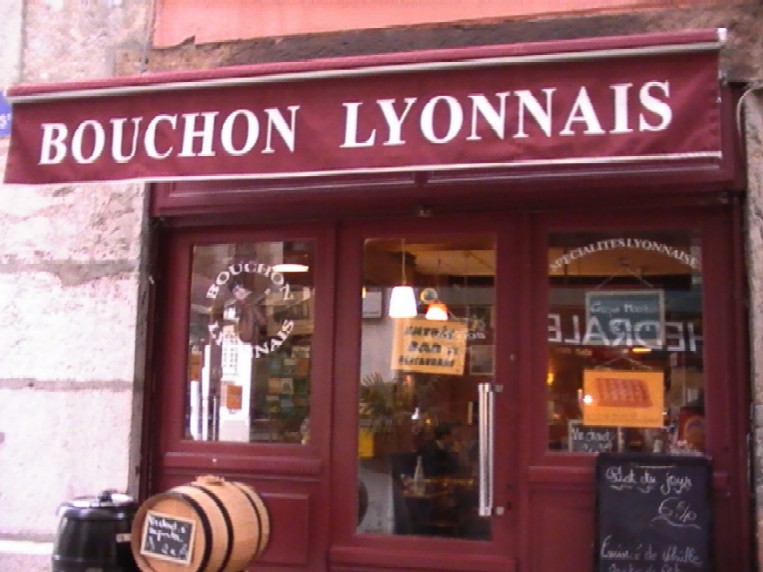
Le Bouchon Lyonnais. A small, cosily informal restaurant specific to Lyon and the surrounding region (though you can find the odd one in other large towns), serving regional specialities. On the menu you’ll usually find quenelles de brochet (a kind of pike dumpling served with a sauce) and, above all, pork and tripe specialities such as boudin (black pudding), different types of saucisson (a pork-based salami) pigs’ trotters and les andouillettes (a tripe sausage). Traditionally the food is washed down with the local Beaujolais or Côtes du Rhône wines which can be purchased by the glass.


Le Salon de Thé. Often known under the English name ‘Tea Room’ the salon de thé is an ideal place for the shopper to rest her weary legs (they’re mainly frequented by women) over a cup of tea, coffee or hot chocolate or, if she prefers, a cold soft drink (a tea room is not licensed to sell alcohol). It’s also a golden opportunity to sample some of the cakes and sweets from the huge range of delightful French confectionary. The salon de thé can be an establishment in its own right, especially in large towns, but can also consist of just a few tables and chairs in the corner of the larger confectioner’s shops.


 Want to know more about France and the French? Get a free PDF copy of 'Barry's Frenglish Folies'. 
                          http://www.calloffrance.com

Sunday, 12 November 2017

French Eating and Drinking Establishments - le Café


Apart from the restaurant which performs a similar function throughout the world (though the French gastronomic version enjoys a unique and deserved international reputation for excellence), France has a plethora of eating and drinking establishments whose various names could create confusion in the mind of the foreign tourist or recently arrived expat as to the purpose they serve and the differences between them – even though distinctions of this kind are becoming increasingly blurred and in many cases the names now used mean more or less the same thing.  The following are the more typically French ones. Let's start with le café. 
Le Café. The café is, of course, the best-known of French drinking (and eating) establishments. Its size is extremely variable and can range from the large Parisian café-restaurant, employing several kitchen, service and bar staff, to the small village café, usually owned and run by a local who is head cook, bottle-washer and waiter (or waitress) all rolled into one. But they all provide a place where shoppers, strollers and tourists can have a bite to eat and slake their thirst, and where regulars can meet to share gossip and a joke over an apéro or two. What’s more, a small-town or village café is an ideal place for the expat to meet and make friends with the locals. There may be a certain amount of suspicion at first, but they'll gradually acknowledge your presence and begin to warm to you. You'll have to be patient, however, as this can take time. And in many cases - especially in the provinces - cafés are frequently the headquarters for a local association or sporting club. And it’s rare to come across a French café which doesn’t have some kind of terrace where you can relax and simply watch the world go by. The larger ones are capable of accommodating scores, while in small villages they are often limited to just a couple of tables with chairs on the pavement outside.
     Most French cafés are licensed to open without interruption from early morning until late at night and serve a wide range of alcoholic, non-alcoholic and hot drinks. And you can always get something to eat at any time of the day. They will serve you with at least a café au lait and croissants for breakfast, and at any other time you can get a snack (at minimum a choice of sandwiches). And even in small towns and villages this can be a more elaborate hot or cold dish and, when there's a demand, some even serve a full plat du jour (usually at lunchtime), eaten inside the café, on the terrace in summer, or in the small restaurant which is sometimes attached.
     Sometimes a café is a bar-tabac : the premises include a small tobacconist's and newsagent’s shop which, like the café, is open all day long, and where you can buy, apart from newspapers and magazines, sweets, chocolate, postcards, stamps and nick-nacks of all kinds – and sometimes even bread. Many are licensed to sell scratch cards and National Lottery tickets. And the larger ones are usually licensed by the PMU (le Pari Mutuel Urbain), a state-controlled betting organization mainly centred on horse-racing.


Interested in France and the French? Why not subscribe to Barry newsletter and get a free Ebook copy of Barry's Frenglish Folies? Just click the following link:        www.calloffrance.com

Saturday, 4 November 2017

Real Camembert?


In a land internationally reputed for both the quality and uniqueness of its traditional food and wine, it's hardly surprising that the French state should have gone to considerable pains to guarantee that the words printed on the bottle, box or package accurately describe the products contained within by instigating a system of norms, labels and 'appellations' which require a producer to respect a certain number of rules and criteria in order to have the right to use a given name. And when it comes to traditional food what could be considered more typically French than such a distinctly flavoured, world-renowned cheese as Camembert?
     Now, as all gourmets certainly know, Camembert is a soft cheese with a slightly salted, flowered crust, made using raw, unpasteurized milk drawn exclusively from the udder of a Normandy breed of cow grazing in Normandy pastures, and which has been moulded by the traditional 'à la loupe' (using a ladle) method, with a minimum fat content of 45%, and a maturing process lasting at least 21 days in one of the five Normandy départements. These same gourmets might also be aware that the cheese owes its name to the small village of Camembert near Vimoutiers in the region of Argentan in Normandy where it was first produced around the time of the1789 Revolution, and that the beginning of its national and international reputation can be traced back to 1863 when the Päris-Granville railway line was inaugurated, and the Emperor Napoléon III tried it (and found it very much to his taste) during a halt at a station along this line. 
     As a result we might be excused for thinking that the box labelled 'Camembert de Normandie' lying on our local supermarket's cheese shelf contains a real Camembert - that's to say one which has been made and matured in strict accordance with the description provided above. Well, I'm sorry to have to inform you that you'd be horribly wrong! For the label 'Camembert from Normandy' simply means what it says: that it's been produced in the geographical region of Normandy with a minimum fat content of 45% - and nothing more! Not only can the milk be either raw or pasteurized, but it can be drawn from the udder of a non-Norman cow which has been grazing in non-Norman pastures in the Jura, in Lorraine, in the Haute-Saône, or anywhere else for that matter. As for the production and ripening process, well, there are simply no requirements at all!  Mind you, it's still reassuring to know that today's biggest French producer of Camembert cheese is located in the Normandy département of the Orne. What's less reassuring, however, are the methods of production which have got nothing to do with the original process.
     The milk (which, I repeat, can come from anywhere) is first heated to 72° for 20 seconds in order to kill all the pathogenic micro-organisms, and especially the active bacterial flora. This results in what is called a 'lait mort' - a dead milk, to which a modicum of life (and taste) is restored by the addition of laboratory-cultivated 'aromatic' ferments (yeast, bacteria fungi). The milk is then curdled by injecting an enzyme found in the stomach of young calves, after which everything is immersed in a solution of brine, and finally sprayed with mould! Even though a Camembert produced in this way offers all necessary hygiene guarantees (at least, let's hope this is the case), can it be guaranteed that the average consumer is fully aware that when he buys a box labelled 'Camembert fabriqué en Normandie' he's buying a cheese which has been made in such a radically different way to that which he's being led to believe, and that if he wants to have the guarantee he's buying the real McCoy, the label on the cheese box should read 'Camembert AOC (Appellation d'Origine Contrôléé) de Normandie?' I'm not so sure. And it's perhaps significant that the production of real Camembert represents just 4.2% of the total quantity of French-produced Camembert.


Want to know more about France and the French? Subscribe to Barry's newsletter at: http://www.calloffrance.com