Showing posts with label Eating and drinking in France. Show all posts

Saturday, 9 December 2017

The Doggy Bag


When you eat in a restaurant in the U.K. or the U.S. you probably wouldn't think twice about asking the waiter for a bag or box so you can take that nice piece of steak you couldn't quite finish home for Rover, or even for yourself. In France, however, the doggy bag is still not quite the done thing – so much so that if you asked for one in a restaurant you might come in for some strange looks from the person serving you, and a good deal of mockery (behind your back) from other diners. But, as a result of the present European year of fight against waste, all this could be about to change.
      For while most French still tend to make fun of the doggy bag, in a world where resources are increasingly limited some restaurants, companies and internet sites are now doing their best to promote this Anglo-Saxon invention as a means of combating waste. And in France where, according to a study conducted in 2011, each person throws away on average 21% of food bought (that's 90 kg of food per year), 8% of which hasn't even been removed from its packaging, this kind of waste is coming in for more and more criticism. And it's the restaurants which seem to be taking the lead. According to a recent survey which questioned 2,700 restaurants in the Rhône-Alpes region restaurant owners' greatest fear is that their customers will become ill after eating left-overs which have not been kept in the best of conditions at home. In this respect, however, they can rest assured as, legally speaking, restaurants can no longer be held responsible for a dish which was started in their restaurant and then taken away in a doggy bag. A total of 31% of the establishments questioned already offer or are thinking of offering a box or bag which customers can use to take uneaten food home. And 86% of them feel that, since the customer has paid for the entire meal, he's entitled to take the left-overs away. It's also a good preparation for 2016 when restaurants will be legally obliged to limit organic waste. 
     What's more, some young entrepreneurs see this as a market opening, and are doing their best to make the bag or box more attractive. This is certainly the case with the Trop bon pour gaspiller (Too Good to Waste) project launched by Laurent and Rabaïa Calvayrac. 'We've lived in North America where the practice is very common,' says Rabaïa. 'When we came back to France we decided to try to make it more popular by improving the quality of the box. We think this is very important.' As a result they've produced a luxury doggy bag - a rigid, recyclable, bio-degradable box suitable for both microwave and normal ovens (up to 180°C), and made in France. The problem is that, in spite of its qualities, only small quantities (5,000) will be produced to begin with. And the cost price will be around 1€, a bit too expensive to hope for massive success, even though those restaurants who have shown interest say they're willing to make an effort as far as the price is concerned. In addition, Rest-o-Resto, a Grenoble-based company, is compiling an online directory of restaurants which offer a doggy bag or box. At present it has 130 addresses from 11 towns. And the numbers are expanding. 'The reactions we get vary from one restaurant to another,' admits Alexandre Teodosio. 'Some owners are very enthusiastic, while for others it's unthinkable that a meal should end up in a bag or box.' The company is in the process of developing a box which will be less upmarket than the Trop bon pour gaspiller one. France's Belgian neighbours, on the other hand, have adopted a different approach to making the doggy bag more acceptable. This involves finding not only a suitable French name but - since most left-overs are taken home for human consumption - one less associated with a canine. It doesn't seem to be an easy task, however, as their site has just launched a Facebook consultation page inviting people to come up with their suggestions. Among these can be found RestopackRestrobon (Restes trop bons pour être jetés = left-overs too good to be thrown away), or even Gaspipa.

Want to know more about France and the French? Why not visit Barry at: www.calloffrance.com 


Saturday, 18 November 2017

French Eating and Drinking Establishments: le bistro, le bar, la brasserie, l'estaminet, le bouchon, le salon de thé.


Le Bistrot (sometimes spelled ‘bistro’). Though the word is now more or less interchangeable with café (especially when it's not very big), a bistrot is a small, informal type of restaurant (originating in Paris but now common in the provinces) serving drinks but, above all, moderately-priced home cooking in a relatively modest setting and available at most times of the day. 


Le Bar. In the past a bar was a place (often located in a railway station, hôtel, airport or even on a train) where you could have a quick drink, either standing or seated on a stool at the counter from where it was possible to observe the barman at work, or even engage him in conversation. Nowadays nothing much distinguishes a bar from a small café and it often has a terrace of some description. And you can usually get a snack there, frequently in the form of standardized fast food. In this case it can be called a snack-bar or simply un snack. In large towns they serve take-away food. A bar can even have a small restaurant attached to it, in which case it goes under the name of ‘bar-restaurant’.

     
La Brasserie. Larger than a bistro and mostly located in large towns, a brasserie was originally a place where beer was brewed and consumed (the word also means 'brewery'). An increasing number are now owned by chain companies. Though they serve all types of alcohol and non-alcoholic beverages, many brasseries still pride themselves on offering a good selection of draught and bottled beers. Their main speciality, however, is food. At one extreme some just serve basic, single dishes (onion soup, cooked meat assortments, seafood, Sauerkraut, etc.) at any time of the day, while the more upmarket brasseries, especially in Paris, can provide quite elaborate, extensive, full-course (and relatively expensive) meals. And in certain cases they can serve both. Advance booking is not normally required.


L’Estaminet. An estaminet is a small, rustic, working-class establishment, halfway between a bar and a restaurant, serving mainly locally brewed beer and where you can eat simple, but copious regional specialities.  They’re to be found in Belgium and Northern France and were originally places where men of the same working corps - miners, textile workers, metal workers, sailors (and even smugglers) would go to have a drink, a smoke, play billiards and skittles as well as hold meetings to discuss matters of professional concern. It’s said that trade unionism and the right to strike were born in the estaminet.


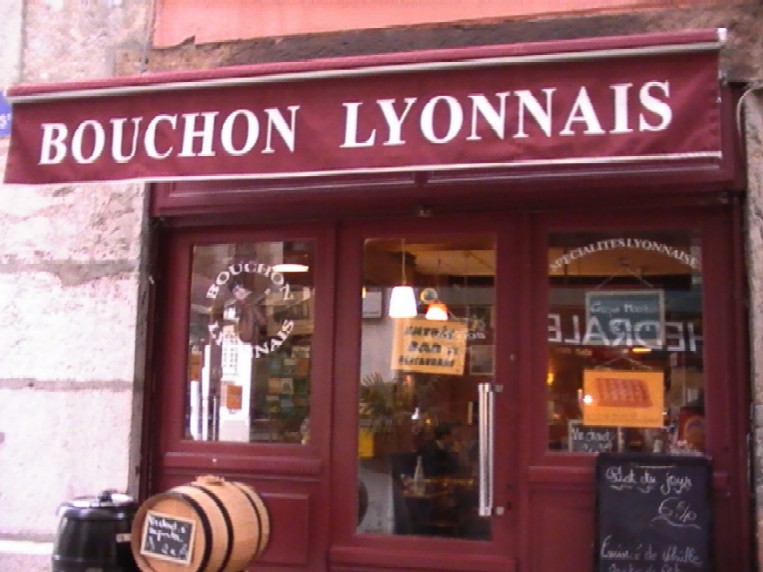
Le Bouchon Lyonnais. A small, cosily informal restaurant specific to Lyon and the surrounding region (though you can find the odd one in other large towns), serving regional specialities. On the menu you’ll usually find quenelles de brochet (a kind of pike dumpling served with a sauce) and, above all, pork and tripe specialities such as boudin (black pudding), different types of saucisson (a pork-based salami) pigs’ trotters and les andouillettes (a tripe sausage). Traditionally the food is washed down with the local Beaujolais or Côtes du Rhône wines which can be purchased by the glass.


Le Salon de Thé. Often known under the English name ‘Tea Room’ the salon de thé is an ideal place for the shopper to rest her weary legs (they’re mainly frequented by women) over a cup of tea, coffee or hot chocolate or, if she prefers, a cold soft drink (a tea room is not licensed to sell alcohol). It’s also a golden opportunity to sample some of the cakes and sweets from the huge range of delightful French confectionary. The salon de thé can be an establishment in its own right, especially in large towns, but can also consist of just a few tables and chairs in the corner of the larger confectioner’s shops.


 Want to know more about France and the French? Get a free PDF copy of 'Barry's Frenglish Folies'. 
                          http://www.calloffrance.com